London
National Portrait Gallery – Queer Britain in Portraits
Open in LGBT History UK →

The Chevalier d’Éon – London’s First Trans Celebrity
1728–1810
NPG 6937 · spy, soldier, fencer
The Chevalier d’Éon was a French spy, diplomat, soldier and fencer who lived much of their life in London. Born in 1728, d’Éon served Louis XV as diplomat and intelligence agent. From 1771 London bookmakers took bets on whether d’Éon was a man or a woman – a public spectacle that ran for years. From 1777 d’Éon permanently lived as a woman, insisting this had always been their true identity, and when the Revolution cut off their French pension, performed in fencing exhibitions in women’s dress to become a celebrated London figure.
They died in poverty in 1810, aged 81. This portrait, painted by Thomas Stewart after Mosnier in 1792, shows d’Éon in women’s dress with the Cross of Saint-Louis pinned to the breast – military honours earned as a man, worn as a woman.
Read more →

Virginia Woolf – Orlando’s Author
1882–1941
NPG P221 · the centre of queer Bloomsbury
Virginia Woolf is the central figure of queer Bloomsbury: bisexual, deeply in love with Vita Sackville-West from 1922, and the author of Orlando (1928) – a novel whose protagonist changes sex across four centuries, and which Vita’s son called “the longest and most charming love letter in literature.” She wrote Mrs Dalloway (1925) with a London so alive with compressed female longing that readers still feel it.
She walked into the River Ouse on 28 March 1941 and did not come back. Orlando has never gone out of print. She wrote it for a woman she loved, and into it she put everything she could not say plainly.
Read more →

Vita Sackville-West – The Garden and the Letter
1892–1962
NPG 6716 · poet, gardener, aristocrat
Vita Sackville-West – poet, novelist, gardener, aristocrat – sits in this photograph with the self-possession of someone who never much cared what you thought. The rightful heir to Knole in Kent who could not inherit it because she was a woman; the wife of diplomat Harold Nicolson in a partnership of equals, each free to love elsewhere; the woman Virginia Woolf fell in love with and wrote Orlando for.
Their affair lasted from 1922 to 1928, their friendship until Woolf’s death. She created the garden at Sissinghurst Castle – one of the most visited in Britain – and is buried there. The portrait shows her before the garden existed. The garden is the portrait she left.
Read more →
Radclyffe Hall – “Give Us the Right to Our Existence”
1880–1943
NPG 4347 · The Well of Loneliness
Radclyffe Hall – born Marguerite, known to friends as “John” – wrote The Well of Loneliness in 1928 and changed the world. The novel follows Stephen Gordon, a woman who loves women, from childhood into adult life. A magistrate declared he “would rather give a healthy boy or a healthy girl a phial of prussic acid than this novel,” and it was prosecuted for obscenity in November 1928.
Published in France and America, it circulated underground in Britain for thirty years – the single most important book for women who had never seen themselves in fiction. Hall wore men’s suits and a monocle and lived with Lady Una Troubridge for 28 years. It was banned. Women hid it under their mattresses. It survived.
Read more →

Gwen John – The Room of Her Own
1876–1939
NPG 4439 · the great painter who worked in silence
Gwen John trained at the Slade in London before moving to Paris, where she spent most of her adult life. She is the least-famous member of the most-famous artistic family of Edwardian London – her brother was the exuberant, celebrated Augustus John – and the contrast is instructive. Gwen worked in silence: small paintings of women in bare rooms, light from a single window, a quality of absolute attention. Her most sustained emotional bonds were with women, recorded in letters of devotion and pain.
When she died in 1939 her studio held over two hundred paintings she had never shown. The world found her when it was ready, and the finding took until the 1970s. Her brother was the famous one. She was the great painter.
Read more →
Alan Turing – The Man Who Saved the World
1912–1954
NPG x27078 · Enigma, and the state’s betrayal
Alan Turing was born in Maida Vale in 1912. He broke the Enigma code at Bletchley Park, shortening the Second World War by an estimated two to four years and saving millions of lives, and he invented the theoretical basis of the modern computer. In 1952 he was prosecuted for “gross indecency” over a relationship with Arnold Murray, and given a choice: prison, or chemical castration. He chose the injections. His security clearance was revoked.
On 7 June 1954 he was found dead beside a half-eaten apple; the inquest returned suicide by cyanide. He was 41. Gordon Brown apologised in 2009; the Queen granted a royal pardon in 2013; his face has been on the £50 note since 2021. The man who saved the world was destroyed by the state he saved.
Read more →

Benjamin Britten and Peter Pears – The Long Partnership
1913–1976
NPG 5136 · forty years, one voice
This 1943 double portrait by Kenneth Green is one of the most intimate male portraits in the collection: Britten at the piano, Pears standing behind him, both absorbed in the music. Benjamin Britten was the most celebrated British composer of the twentieth century; Peter Pears was his life partner, the tenor for whom he wrote his finest vocal music. They met in 1934 and were together until Britten’s death.
They co-founded the Aldeburgh Festival in 1948, which continues today. Britten’s opera Peter Grimes (1945) – about an outsider destroyed by a community that cannot understand him – was heard at its premiere as an allegory of gay experience. When the 1967 Sexual Offences Act passed, Britten wrote to a friend: “At last.” He wrote music for a voice he loved, and the voice sang it for forty years.
Read more →

Oscar Wilde – Portrait of a Martyr
1854–1900
NPG 2265 · the most famous victim of the law
The Gallery holds several portraits of Oscar Wilde, including the famous 1882 Napoleon Sarony photographs from his American tour. Wilde lived in London from 1878, becoming the most celebrated wit of his age and the most famous victim of the law against gay men. He lived at 34 Tite Street, Chelsea (a stop on the Chelsea tour), where he wrote The Importance of Being Earnest and The Picture of Dorian Gray.
He was arrested in April 1895 at the Cadogan Hotel after suing the Marquess of Queensberry for libel – and losing. Convicted of gross indecency, he served two years’ hard labour and died in Paris in 1900. His grave at Père Lachaise is covered, to this day, in lipstick kisses. When they came to arrest him, he stayed.
Read more →
Jan Morris – The Long Journey Home
1926–2020
NPG 6722 · the Everest scoop, and her own story
Jan Morris was, as James Morris, the journalist who sent news of the first Everest summit to The Times by coded telegram on 29 May 1953. From earliest childhood she had known she was in the wrong body. She married Elizabeth Tuckniss in 1949 and they had five children. In 1972 she had surgery in Casablanca; British law then required dissolution of the marriage first, so when same-sex marriage was legalised, Jan and Elizabeth quietly married again in 2008.
Her memoir Conundrum (1974) is one of the finest pieces of writing about trans experience ever published. She died in November 2020 in Wales, aged 94. She filed the scoop of the century; the story she could not yet file was her own. They had been together for sixty years.
Read more →
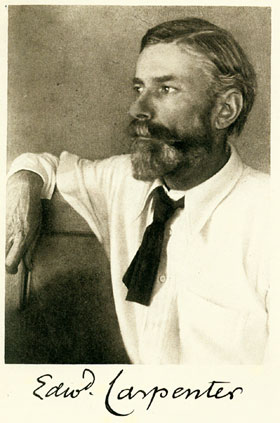
Edward Carpenter – The Sandalled Sage
1844–1929
NPG 2447 · who named the love without shame
Edward Carpenter was one of the first people in Britain to argue publicly, in print, that same-sex love was natural, healthy and good. A Cambridge-educated socialist, he abandoned academia for a smallholding near Sheffield and spent forty years writing and campaigning for what he called “the homogenic emotion.” His 1894 essay The Intermediate Sex and his poem Towards Democracy were read by a generation who had never seen their own experience named without shame.
E.M. Forster read Carpenter and wrote Maurice; D.H. Lawrence was influenced by him. He lived openly with his partner George Merrill for decades. He wore sandals, grew vegetables, and wrote the first book in English to say – in print, under his own name – that love between men was a gift, not a disease.
Read more →
Francis Bacon – The Face Behind the Mask
1909–1992
NPG 5844 · openly gay when it was illegal
This bronze cast of Francis Bacon’s face, made by Eduardo Paolozzi in 1957, shows the painter at the height of his powers. Bacon was openly gay in an era when it was illegal: he drank openly in Soho – the Colony Room and the French House, both stops on the Soho tour – painted his lovers openly, and spoke plainly about his sexual life in interviews.
His lovers became his subjects; George Dyer in particular, who died in a Paris hotel on the eve of Bacon’s 1971 retrospective, haunted him for the rest of his life. He worked at 7 Reece Mews, South Kensington – the final stop on the Chelsea tour – until the day he died. Asked about his sexuality he simply said: “I am homosexual.” In 1963, that took nerve.
Read more →
Jackie Kay – The Queer History That Is Still Continuing
b.1961
NPG P1356 · Makar, and the present tense
Jackie Kay was adopted as a baby – her mother Scottish, her father Nigerian – and raised by white Communist activist parents in Glasgow. Her debut collection The Adoption Papers (1991) is a polyphonic masterpiece in three voices. Her novel Trumpet (1998), inspired by the real story of jazz musician Billy Tipton whose gender was discovered after death, was one of the first major British novels to centre a trans character’s inner life with full seriousness.
Kay has been openly lesbian throughout her public life, and in 2016 was appointed National Poet of Scotland – Makar – the first Black person to hold the role. She brings us into the present: the queer history in these galleries is not past. It is continuing.
Read more →